
When choosing the right mortgage, whether you’re a couple buying your first home or on to your third home, it’s essential to look at all the facts. Buying a home is a huge financial decision. Being equipped with the right knowledge will ensure your clients have the right strategy.
A 15-year mortgage has the appeal of a quick payoff, but is it better than a 30-year mortgage? Some people would say yes. We’ll show you how to figure it out the Prosperity Economics way.
What is a “Typical Financial Planning” Mortgage?
The 15-year mortgage:
- Less cumulative* interest paid
- Lower interest rate
- Shorter time, higher payment, lower monthly savings
- Any additional cash flow applied to the mortgage to build home equity
- Some inflation benefit
- Some interest deduction
Most of those bullet-points sound pretty nice, right? So why is a 15-year mortgage not necessarily the best choice? I’ll give you a hint: the third bullet point is key.
What is a “Prosperity Economics” Mortgage?
The 30-year mortgage:
- Less actual net compound** cost
- Higher interest rate
- Longer time, lower payment, higher monthly savings
- Any additional cash flow applied to a “side fund” builds savings outside of the equity
- More inflation benefit
- More interest deduction
A 30-year mortgage is starting to sound pretty good, right? The thought of such a long payment period, coupled with a perceived greater interest payment, often holds clients back. Realistically, the 30-year mortgage offers more financial freedom. Choosing the Right Mortgage.
Let’s look at the idea in action.
Comparing the 15-year Mortgage and 30-year Mortgage
Mr. Client is buying a house for $250,000 and needs a loan of the same value. Fortunately, both a 15-year mortgage and a 30-year mortgage have the same interest rate of 4.5% at his bank of choice. If he goes with the faster repayment schedule, his monthly payments are about $1,912. The 30-year mortgage is a little easier on his wallet at $1,266 a month. But Mr. Client is hesitant to have debt that will take so long to pay off. And he’s going to have to pay more interest, right?

To show Mr. Client a comparison, we’ve used the Loan Analysis calculator. Comparatively, it seems like the 30-year mortgage is going to cost a lot more in the long run. What the calculator doesn’t account for is the time value of money, also called opportunity cost.
The Cost of Cash
Say Mr. Client had the cash to pay for the house up front. In theory, he would save all of that interest payment. Mathematically, it’s true. What he misses out on is the opportunity of putting those dollars to work somewhere else. Using our Future Value calculator, we’ll take a look:
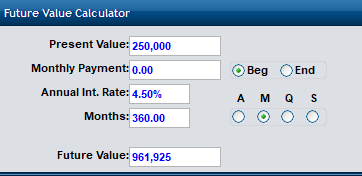
If Mr. Client had saved that same $250,000 over a 30-year period, at a rate of savings that matched his interest payment, he’d have $961,925. That’s almost $1 million, just from letting that money sit and compound somewhere. So although paying for the house in cash SEEMS like a good idea—after all, you’re saving all of that interest cost—the client is losing the long-term opportunity of saving that money and what it could do for him.
To reiterate: if the client chooses a mortgage, he’s choosing to pay roughly $94,000 to $206,000 worth of interest on his house. That seems like a lot, and if he has $250,000 in cash, why wouldn’t he pay for the house? He’ll save $100,000, right? And yet, that’s $100k over 30 years. And if he pays in cash, he can’t SAVE that $250,000. Yet, if he did, in the same 30 years, he would almost have $1 million. Why would anyone give up $1 million to save $200,000? And yet, people do not think in terms of opportunity cost.
The Cost of Mortgage Payments
We can analyze that same cost on both the 30-year mortgage and the 15-year mortgage. If we plug in the monthly payments of each mortgage in the Future Value calculator, you’ll see the opportunity cost:
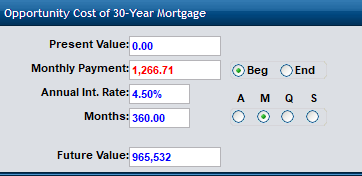

The 15-year (180-month) mortgage still seems better! Right…?
What makes this comparison misleading is the fact that they aren’t compared over the same time frame. If we apply the future value of Mr. Client’s payments at the same rate over another 180 months, we get this:
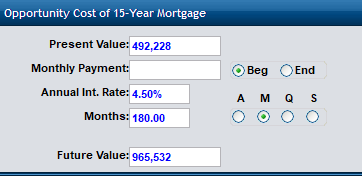
The same exact opportunity cost that you get if you pay in cash, or over 30 years. Over that time frame, Mr. Client’s money paid in the first 15 years will still cost him the same dollars of opportunity.
So are any of these options better, if they ALL cost the same in the long run?
Revisit our “Prosperity Economics Mortgage” list above, and you’ll start to see why it’s the better option. Lower monthly payments allow Mr. Client to save more right away. He doesn’t have to wait until his house is paid off to save. If opportunities pop up along the way, he’ll have an account to pull from to pay for them. The 15-year mortgage may leave Mr. Client more strapped for cash and unable to save anything, while paying in cash he may be able to save those would-be mortgage payments, but he would have to start his opportunity fund from the ground up.
Saving the Difference
If Mr. Client uses a whole life insurance policy as a savings vehicle, his money can even grow at a higher rate than typical savings. And, when he wants to spring on an opportunity, he can borrow against his cash value without reducing what’s in his account. That way, his account will continue to grow!
Here’s what it would look like if Mr. Client had a 30-year mortgage and saved the difference at the same rate:
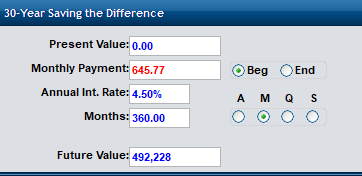
He would have accessible cash over 30 years for the same value as the opportunity cost of 15-years of high payments. That’s a lot to digest. Sure, the client could do the same by paying off his house in 15 years and then saving that money for the remaining 180 months. However, this would mean he’s got no additional savings during his 15 years of home ownership. A lot of things can happen in 15 years.
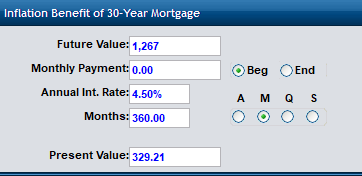
And that inflation benefit? If we use a Present Value calculator, you can see that his very last payment will feel like $329 of today’s dollars. A 15-year mortgage won’t get inflation benefits quite like that.
So what are some of the 15-Year myths?
- Equity increases the value of the house
- More equity increases the owner’s financial strength and provides more control
- Safer risk position from cash flow reduction issues (loss of job, disability, or emergency)
- Cumulative* interest paid is the cost of the mortgage
The reality is:
- Higher equity reduces the loan balance but does not affect the value of the house, which is determined solely by the market.
- More equity causes less negotiating strength with the financial institution. To access the equity, you must sell the home or qualify for financing to borrow against it.
- Extra equity can cause a loss of the property due to a reduction in the amount of available cash outside of the house for emergencies.
- Total payments minus the tax deduction compounded** at a COM*** rate is a real cost.
So, Are You Choosing the Right Mortgage?
With all of this to consider, a 30-mortgage seems like the right way to go. It keeps the client in control of their assets and their home. It provides the option to keep money where it’s liquid and accessible, not locked up in home equity.
Walk your clients through the Seven Principles for Prosperity, and choosing the right mortgage will be simple! The principles of Prosperity Economics teach people how to think through everyday financial decisions. We’re preparing clients for success!
*cumulative: simple addition of all payments
**compounded: payments grown by an interest rate over time
***COM: cost of money. A personal earnings rate based upon a weighted average of savings or investment earnings and financing rates currently experienced (i.e. 4%)
Learn with Us!
Want to learn even more ways to utilize Loan Analysis and think about mortgages? Join us at a Truth Training, where we’ll look at various ways to get the most from this and other calculators.
